An Essay on the Principle of Population
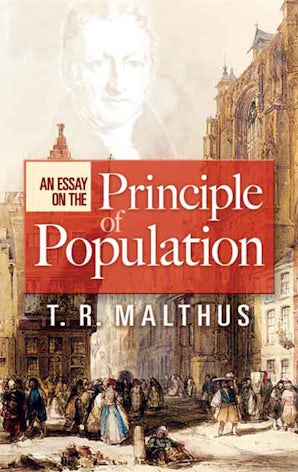
The first major study of population size and its tremendous importance to the character and quality of society, this polemic examines the tendency of human numbers to outstrip their resources. Pivotal in establishing the field of demography, it remains crucial to understanding modern problems with food production and distribution.
Anglican parson Thomas Robert Malthus wrote his famous essay in 1798 in response to speculations on social perfectibility aroused by the French Revolution. Because human powers of procreation so greatly exceed the production of food, Malthus explained, population will always exceed available resources, and many will inevitably live at the ragged edge of subsistence. His simple yet powerful argument — demonstrating that scarcity and inequality arise even in a society purged of all unjust laws and institutions — was highly controversial in its day. Many of Malthus' contemporaries despised him for dashing their hopes of social progress, and the grim logic of his "population principle" led Thomas Carlyle to dub economics "the dismal science."
Today, Malthus' name is practically synonymous with active concern about demographic and ecological prospects, and his classic remains ever relevant to issues of social policy, theology, evolution, and the environment.
Anglican parson Thomas Robert Malthus wrote his famous essay in 1798 in response to speculations on social perfectibility aroused by the French Revolution. Because human powers of procreation so greatly exceed the production of food, Malthus explained, population will always exceed available resources, and many will inevitably live at the ragged edge of subsistence. His simple yet powerful argument — demonstrating that scarcity and inequality arise even in a society purged of all unjust laws and institutions — was highly controversial in its day. Many of Malthus' contemporaries despised him for dashing their hopes of social progress, and the grim logic of his "population principle" led Thomas Carlyle to dub economics "the dismal science."
Today, Malthus' name is practically synonymous with active concern about demographic and ecological prospects, and his classic remains ever relevant to issues of social policy, theology, evolution, and the environment.
Reprint of J. Johnson, London, 1798 edition.
The first major study of population size and its tremendous importance to the character and quality of society, this polemic examines the tendency of human numbers to outstrip their resources. Pivotal in establishing the field of demography, it remains crucial to understanding modern problems with food production and distribution.
Anglican parson Thomas Robert Malthus wrote his famous essay in 1798 in response to speculations on social perfectibility aroused by the French Revolution. Because human powers of procreation so greatly exceed the production of food, Malthus explained, population will always exceed available resources, and many will inevitably live at the ragged edge of subsistence. His simple yet powerful argument — demonstrating that scarcity and inequality arise even in a society purged of all unjust laws and institutions — was highly controversial in its day. Many of Malthus' contemporaries despised him for dashing their hopes of social progress, and the grim logic of his "population principle" led Thomas Carlyle to dub economics "the dismal science."
Today, Malthus' name is practically synonymous with active concern about demographic and ecological prospects, and his classic remains ever relevant to issues of social policy, theology, evolution, and the environment.
Anglican parson Thomas Robert Malthus wrote his famous essay in 1798 in response to speculations on social perfectibility aroused by the French Revolution. Because human powers of procreation so greatly exceed the production of food, Malthus explained, population will always exceed available resources, and many will inevitably live at the ragged edge of subsistence. His simple yet powerful argument — demonstrating that scarcity and inequality arise even in a society purged of all unjust laws and institutions — was highly controversial in its day. Many of Malthus' contemporaries despised him for dashing their hopes of social progress, and the grim logic of his "population principle" led Thomas Carlyle to dub economics "the dismal science."
Today, Malthus' name is practically synonymous with active concern about demographic and ecological prospects, and his classic remains ever relevant to issues of social policy, theology, evolution, and the environment.
Reprint of J. Johnson, London, 1798 edition.
$2.78
Original: $7.95
-65%An Essay on the Principle of Population—
$7.95
$2.78Description
The first major study of population size and its tremendous importance to the character and quality of society, this polemic examines the tendency of human numbers to outstrip their resources. Pivotal in establishing the field of demography, it remains crucial to understanding modern problems with food production and distribution.
Anglican parson Thomas Robert Malthus wrote his famous essay in 1798 in response to speculations on social perfectibility aroused by the French Revolution. Because human powers of procreation so greatly exceed the production of food, Malthus explained, population will always exceed available resources, and many will inevitably live at the ragged edge of subsistence. His simple yet powerful argument — demonstrating that scarcity and inequality arise even in a society purged of all unjust laws and institutions — was highly controversial in its day. Many of Malthus' contemporaries despised him for dashing their hopes of social progress, and the grim logic of his "population principle" led Thomas Carlyle to dub economics "the dismal science."
Today, Malthus' name is practically synonymous with active concern about demographic and ecological prospects, and his classic remains ever relevant to issues of social policy, theology, evolution, and the environment.
Anglican parson Thomas Robert Malthus wrote his famous essay in 1798 in response to speculations on social perfectibility aroused by the French Revolution. Because human powers of procreation so greatly exceed the production of food, Malthus explained, population will always exceed available resources, and many will inevitably live at the ragged edge of subsistence. His simple yet powerful argument — demonstrating that scarcity and inequality arise even in a society purged of all unjust laws and institutions — was highly controversial in its day. Many of Malthus' contemporaries despised him for dashing their hopes of social progress, and the grim logic of his "population principle" led Thomas Carlyle to dub economics "the dismal science."
Today, Malthus' name is practically synonymous with active concern about demographic and ecological prospects, and his classic remains ever relevant to issues of social policy, theology, evolution, and the environment.
Reprint of J. Johnson, London, 1798 edition.